Friday, November 20, 2015

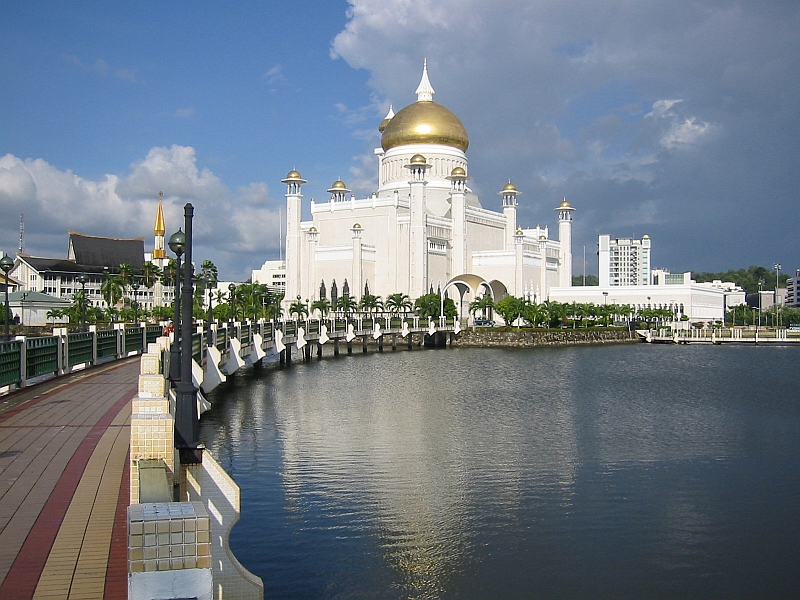
Islam in Brunei

The Great Mosque in Brunei


Islam is Brunei's official religion, 67 percent of the population is Muslim,[1][2][3] mostly Sunnis of Malay origin who follow the Shafi school of Islamic law. Most of the other Muslim groups are Kedayans (converts from indigenous tribal groups) and Chinese converts.[4]

History


Islam was adopted in the 15th century when a Malay Muslim was installed as sultan. The sultan traditionally was responsible for upholding Islamic traditions, although the responsibility was usually delegated to appointed officials.

Since the 1930s sultans have used rising oil revenues to provide an extensive social welfare system and promote Islam, including subsidizing the Hajj, building mosques, and expanding the Department of Religious Affairs.

With the constitution in 1959, Islam became the official religion of the country.[5]

On 30 April 2014, Sultan Hassanal Bolkiah announced the implementation and enforcement of the first phase of Sharia law in Brunei starting 1 May 2014.[6]

References


  • CIA The World Factbook - Brunei
  • Religious Intelligence - Brunei[dead link]
  • Religious Freedom - Brunei
  • Islamic banking in Southeast Asia, Islam in Brunei pushes other religions out of the way . E.g. The ban on alcohol, The ban on the teachings of other religions etc. This is often widely criticised, The Government always attempts to hide this. By Mohamed Ariff, Institute of Southeast Asian Studies, pg. 24
  • http://www.bt.com.bn/art-culture/2010/03/08/golden-history-islam-brunei
  • http://www.theguardian.com/world/2014/apr/30/sultan-brunei-sharia-penal-code-flogging-death-stoning

Saturday, November 14, 2015

Umm Salamah bint Abu Umayyah

Umm Salamah bint Abu Umayyah


The Prophet (peace and blessings be upon him) said:

"Allah has commanded me to marry only with the women of Paradise. "Umm Salamah participated in the Ridwan pledge; therefore, she deserved the Paradise.

Her real name was Hind bint Abu Umayyah who became famous by the name Umm Salamah. She was noble by birth, intelligent, learned, wise and skillful. She was first married to 'Abdullah bin 'Abdul Asad Makhzumi known as Abu Salamah. He was the son of the Prophet's paternal aunt Barrah bint Abdul Muttalib. He too belonged to the select band of people who were the first to accept Islam. He was known for his integrity, valour, generosity, tolerance and patience. He was the eleventh person to come into the fold of Islam. He was also the foster brother of the Prophet (peace and blessings be upon him) through the ties of breast-feeding.

Umm Salamah was also one of the earliest converts to Islam. Her mother was 'Atikah bint 'Amer bin Rabi'ah bin Malik bin Khazimah. Her father Abu Umayyah bin 'Abdullah bin 'Amr bin Makhzum was a very wealthy man and famous throughout the Arab world for his public service and charity. Umm Salamah seemed to have inherited this trait from her father. She was always amiable and kind to her neighbors. When she married the handsome and brave son of the equally wealthy family of Makhzum, she carried a friendly demeanor of pleasant serenity into her new household. There was an atmosphere of gaiety and love in the home of the newly married couple.

But things changed radically when the couple embraced Islam. The whole family turned against them; mischievous and wicked elements like Walid bin Mughirah Makhzumi started creating problems for them. Finally, when matters had nearly reached their worst, the Prophet (peace and blessings be upon him) advised his staunch followers to migrate to Abyssinia where the Christian King was more tolerant of the new religion. Sixteen people set out on that historic first migration of the followers of Islam - twelve men and four women, Abu and Umm Salamah were part of these sixteen.

Umm Salamah narrated that life was very peaceful in Abyssinia, free of all religious persecution. She first gave birth to a daughter, whom they named Zaynab. Then she had a son Salamah, hence her name and her husband's name.

The next child was also a son, 'Umar. Finally they had another daughter who they named Durrah. So life was very smooth and time passed uneventfully, in peace and happiness. The ruler of Abyssinia, Najashi, was very kind to the migrants. When the leaders of the disbelievers heard this news they were enraged and thought that the Muslims were becoming a real source of danger for them. They decided to take strong measures to stem the rising tide of Islam.

After a great deal of thought they evolved a plan of action. The disbelievers sent the leading politician of the Arab world, Amr bin 'Aas and 'Abdullah bin Abi Rabi'ah with expensive gifts for Najashi, in order to persuade him to hand over the Muslim migrants to their custody. Najashi was a fair minded, far-sighted and frank man. So he called for the leader of the refugees to present their case. Najashi, after hearing the plea of the Muslims he then told the emissaries of the Quraysh that these migrants were people of good character and could continue to live in Abyssinia as long as they wished. Further, he would continue to give every kind of protection necessary, and the delegation from Makkah could leave carrying back their gifts. If someone gave him even a mountain of gold in exchange for these righteous people he would not surrender them. Umm Salamah has written about this memorable first migration of the Muslims, and described the greatness of Najashi in such a moving manner that it has become an integral and important part of Islamic history.

Umm Salamah narrates that their life in Abyssinian was very peaceful and Najashi was very kind, but all the same they were homesick for Makkah. They continued longing for the time when peace would finally prevail so they could return to their beloved country. One day news reached that 'Umar bin Khattab accepted Islam and that the conditions in Makkah had changed completely. It was said that because of the authority and influence of 'Umar the persecution of Muslims came to an end. They were all so excited at this good news, writes Umm Salamah that they decided to set out for their homes. 'Uthman bin 'Affan also set out with them with his family. On reaching Makkah they realized it had been just a rumor and things were much worse than before. Muslims were the targets of worse crimes and persecution. But it was too late.

An accepted tradition states what had actually happened. The disbelievers heard the Prophet (peace and blessings be upon him) reciting Ayat from the Noble Quran, and prostrated involuntarily at one Ayah with him. Like all rumors this too ballooned into news that the Quraysh had converted to Islam. In reality this was not so.

Weary of the constant problems they faced, they decided to leave for Abyssinia again. It was at this time that the Prophet (peace and blessings be upon him) ordered staunch Muslims to migrate to Al-Madinah. The delegation from there had brought the news that those who swore allegiance to Allah and His Prophet (peace and blessings be upon him) at 'Aqabah had invited Muslims to settle there, and he accepted. The Ansar of Al-Madinah, (as they came to be called), had said they would look after their migrant brethren.

Abu Salamah with his family left on camels for Al-Madinah. When members of her family saw this they caught the bridle of the camel and told him that he could go where he wanted but he would have to leave behind their daughter. They said it seemed like a joke - he was always off somewhere or the other, Abyssinia, then Al-Madinah! He never seemed to give her a peaceful settled life.

When Abu Salamah's family heard this they were enraged. They came and took her sons away, saying she could not take them with her; they were their flesh and blood and they would bring them up. So, in a moment the whole family was split up in three different places. Abu Salamah left for Al-Madinah, his wife was left with her parents and the sons were with the paternal grandparents. It was such a shock being torn apart from husband and sons, that she just could not stop weeping. Every day she used to visit the spot from where the husband and children had been torn away from her and weep for her loved ones. One day one of the members of her tribe passed that way and saw her grieving and asked her what happened. She told him about her plight. He then went and gave a piece of his mind to the elders of both families, rebuking them for their cruel behavior towards a noble and helpless lady. His emotional and blunt outburst made them realize how unjust they were and they relented. They gave back her sons to her, and her family too gave her permission to proceed to Al-Madinah.

But how could she travel alone? No one was willing to accompany her. Finally, gaining courage and solace from the fact that she now had her sons with her, she set out for Al-Madinah. When she reached Tan'im she met 'Uthman bin Talhah 'Abdari, who had not up to that time converted to Islam. He asked her where she was traveling all alone. She replied that she was going to join her husband. He was surprised that not a single member of the family accompanied her. She said no one agreed to go with her and she was totally dependent on Allah Almighty who was her Defender and Protector; only He would protect her. 'Uthman bin Talhah 'Abdari took the bridle of the camel and said he would help her in reaching destination.

Umm Salamah said that such a decent, pure-hearted man, with not a trace of evil in him would be difficult to find. Whenever they reached a camping site he would tie the camel to a tree and move far away to lie down and rest. So she also had some privacy and could rest at ease, relaxed with her children. When it was time to resume the journey he would bring the camel and make it sit down. Once she got on the camel's back with her children, he would take the bridle in his hand and start walking. After several days they reached Quba which is in the environs of Al-Madinah. Banu 'Amr bin 'Auf were settled there; he said that since Abu Salamah was also there he could leave her and return. Umm Salamah says in her book that his gentlemanly behavior and his goodness affected her deeply. When she finally saw her family after so long her joy knew no bounds. So this divided family once again was at peace and the children had the benefit of a good upbringing that only united and happy parents can provide.

Abu Salamah took part in the Battle of Badr and once again had the honor of fighting for Islam in the Battle of Uhud. But in this last mentioned battle Abu Usamah Jashmi wounded him seriously in the side with his spear. He underwent treatment for a month but to no avail. The wound apparently healed, but that was only on the surface, and it continued to fester inside. Barely two months after the battle of Uhud the Prophet (peace and blessings be upon him) received news that Banu Asad was planning to attack the Muslims. He ordered his men to prepare for battle, and made Abu Salamah the Commander of the Islamic forces. The battle was won, and Banu Asad was crushed. The Muslims got the rich spoils of a war well fought. Abu Salamah was lying in a very serious condition when the Prophet (peace and blessings be upon him) came to visit him. He realized that he was approaching death, and patting his hand consoled him. The Prophet (peace and blessings be upon him) prayed for him and Abu Salamah, also prayed and asked Allah to give his family a protector and provider like him. And he also asked Him to give Umm Salamah a husband who would give her neither sorrow nor hardship.

After this prayer he passed away. The Prophet (peace and blessings be upon him) closed his eyes with his hands. Umm Salamah often thought of her husband's last prayer for her and wondered who could possibly be better than Abu Salamah. She asked the Prophet (peace and blessings be upon him) what she should ask Allah for herself. He taught her to pray for forgiveness both for herself and for Abu Salamah and ask Allah to give her a better future.

Umm Salamah says that she prayed thus and Allah granted her prayer. When she finished the prescribed period of waiting, Abu Bakr As-Siddiq sent a proposal of marriage to her, but she refused. Then 'Umar bin Khattab proposed and she refused him as well. Then the Prophet (peace and blessings be upon him) proposed. She told him that she had three reservations regarding his proposal. She was hot-headed and had a temper; she felt she might be rude to the Prophet of Allah (peace and blessings be upon him), and thus lose the reward for all her good deeds. Secondly, she was an elderly lady; thirdly, she had, many children. The Prophet (peace and blessings be upon him) answered that he would pray to Allah, and Allah willing, her temper would subside. As far as age was concerned, he was also an elderly man. Thirdly, as far as her children were concerned - that was the precise reason for proposing to her - he wished to be their guardian and share the responsibility. She writes that this answer gave her great happiness and thus she attained the honor of becoming part of the Prophet's household. Thus Allah granted both hers and Abu Salamah's prayer, and she married the Prophet (peace and blessings be upon him) in the month of Shawwal, in the 4th, year after Hijrah.

'Ayshah narrated that it was the habit of the Prophet (peace and blessings be upon him) to visit each of his wives in turn after the 'Asr prayers. He would inquire about their welfare and if they needed anything. He would start from the apartment of Umm Salamah because she was the eldest among them, and finish his rounds at the apartment of 'Ayshah.

Umm Salamah, because of her beauty, knowledge and wisdom held an eminent position. After the truce of Hudaybiyah, the Prophet (peace and blessings be upon him) ordered his Companions to sacrifice the animals they brought along for the purpose, and shave their heads. But they all seemed reluctant and did not rise to obey his command. When Umm Salamah saw the situation she suggested that he should not speak about the subject to anyone, but just go out from the tent and offer the sacrifice and shave his head. Then he could see the effect of his action. And what she expected happened - all the Companions followed suit.

Umm Salamah was a very astute and wise lady. She was educated and was very devoted to the welfare of the destitute and needy.

Several of the Ayat of the Noble Quran were revealed to the Prophet (peace and blessings be upon him) when he was in her apartment. For instance, Ayat in Surat AI-Ahzab,

"And Allah only wishes to remove evil deeds from you, O members of the family (of the Prophet), and to purify you with a through purification." [Noble Quran 33:33]

Also some of the Ayat of Surat At-Tawbah were revealed while he was with her.

"And (there are) others who have acknowledged their sins, they have mixed a deed that was righteous with another that was evil. Perhaps Allah will turn unto them in forgiveness. Surely, Allah is Oft-Forgiving, Most Merciful." [Noble Quran 9:102]

He also said:

"And (He forgave) the three who did not join till for them the earth, vast as it is, was straitened and their own selves were straitened to them, and they perceived that there is no fleeing from Allah and no refuge but with Him. Then He forgave them that they might beg for His pardon. Verily, Allah is the One Who forgives and accepts repentance, Most Merciful." [Noble Quran 9:118]

This Ayah refers to the turning towards Allah of Ka'b bin Malik, Hilal bin Umayyah and Mararah bin Ar-Rabi' in sincere repentance. These three Companions, without any valid reason, avoided joining the Muslim army in the Battle of Tabuk. They were therefore ostracized by the Prophet (peace and blessings be upon him) and the rest of the Companions. They were so stricken by guilt that they kept praying for Divine Forgiveness, until finally Allah granted it to them. The Prophet (peace and blessings be upon him) was sleeping in the apartment of Umm Salamah when this last Ayah was revealed to him. He woke up in the late hours of the night and told her that the supplications for forgiveness of these three Companions had been accepted. She asked him if this good news should be conveyed to them immediately. He said they should not be disturbed so late at night; after the Fajr prayers he sent for them and congratulated them. They were overjoyed and so were all the other Companions.

Umm Salamah also had the distinction of taking part in many battles of significance in the history of Islam. She was with the Prophet (peace and blessings be upon him) during the Battles Bani Mustalaq, Ta'if, Khaybar, Hunayn and the conquest of Makkah. She was present at the signing of the historic treaty of Hudaybiyah or Ridwan the oath of allegiance taken place.

Salman Al-Farsi narrates that someone mentioned to him that the Angel Jibril had come down from the Heavens and was in conversation with the Prophet (peace and blessings be upon him). When he went there he saw that the person with the Prophet (peace and blessings be upon him) was Dahiah Al-Kalbi, and that Umm Salamah was also present. When conversation ended, the Prophet (peace and blessings be upon him) asked if they knew who that gentleman was. She said he was one of his most faithful followers, Dahiah Al-Kalbi. Thereupon the Prophet (peace and blessings be upon him) told her, smiling, that it was actually the Angel Jibril in human guise.

Umm Salamah was very learned in religious matters. She knew three hundred and eighty-seven Hadiths of the Prophet (peace and blessings be upon him) by heart. She knew very well the finer points of Islamic law about foster-relations through suckling and divorce. 'Abdullah bin 'Abbas used to consult with her for many points of Shari'ah, (Islamic law). Leading the list of names of Companions whose judgments on points of law were regarded as valid is the name of Umm Salamah.

Umm Salamah had hardly any equal in mastery over language. When she spoke her words and phrases were well chosen and exactly appropriate for the expression of ideas. Her written language was suited for literary expression. Many companions and followers have noted down traditions attributed to her.

She lived to the ripe old age of eighty-four and died in the year 62nd after Hijrah. She lived to see the rule Khulafa' Ar-Rashidin. Zaynab bint Jahash was the first among the Mothers of the Believers to pass away and Umm Salamah the last. This was during the rule of Yazid bin Mu'awiyah and she was laid to rest beside the other wives of the Prophet (peace and blessings be upon him) in Jannatul Baqi'.

"O the one in (complete) rest and satisfaction! Come back to your Lord - well pleased and well pleasing. Enter you then among My (honored) servants, and enter you My Paradise." [Noble Quran 89:27-30]

Source: "Great Women of Islam" - by Dar-us-Salam Publications
'Jihadi John': US 'reasonably certain' strike killed IS militant

'Jihadi John': US 'reasonably certain' strike killed IS militant


The Pentagon says it is "reasonably certain" that a US drone strike in Syria has killed the Islamic State militant known as "Jihadi John".

Col Steve Warren said Thursday's attack in Raqqa had hit the intended target, but it would take time to "formally declare that we have had success".
Mohammed Emwazi, a Kuwaiti-born British militant, appeared in videos of the beheadings of Western hostages.

UK PM David Cameron said targeting Emwazi was "the right thing to do".
It is believed there was one other person in the vehicle targeted in the strike.
Col Warren said such "routine" attacks had killed on average "one mid- to upper-level IS leader every two days" since May.

However, the death of Emwazi would be a "significant blow" to IS, even though he had not been an "operational or major figure" for IS.
Who is Mohammed Emwazi?

'Jihadi John' movement mapped
Emwazi 'claimed harassment'


Separately, Turkish officials in Istanbul say they have detained a British man, believed to be Aine Lesley Davis, an alleged accomplice to "Jihadi John". Aine Davis is believed to have been guarding foreign prisoners in Syria.

'Strike at IS heart'


Speaking outside Downing Street, Mr Cameron said it was not certain whether the strike was successful, but the UK had been working with the US "literally around the clock" to track Emwazi down.

He said any successful attack would have been "a strike at the heart" of Islamic State (IS), and would demonstrate to those who would harm Britain that "we have a long reach, we have unwavering determination and we never forget about our citizens".
Three drones - one British and two American - were involved in the strike. One of the American drones hit the militants' car.

Who are Britain's jihadists?
How do you verify a militant's death?

Emwazi appeared in beheading videos of victims including British aid worker David Haines and taxi driver Alan Henning.

Mr Haines's daughter Bethany said she felt an "instant sense of relief" upon hearing reports of Emwazi's possible death, "knowing he wouldn't appear in anymore horrific videos."
"He was only a pawn in Isis's stupid game, but knowing it's over, that he's finally dead, still hasn't sunk in," she said in a statement.

"As much as I wanted him dead I also wanted answers as to why he did it, why my dad, how did it make a difference?"

'Mixed feelings'


The Henning family were informed on Thursday night by a government contact that the strike had taken place, the BBC understands.

Stuart Henning, Mr Henning's nephew, wrote on Twitter: "Mixed feelings today wanted the coward behind the mask to suffer the way Alan and his friends did but also glad it's been destroyed."
Labour leader Jeremy Corbyn said it appeared Emwazi had been "held to account for his callous and brutal crimes".
"However, it would have been far better for us all if he had been held to account in a court of law," he said.

Analysis: Frank Gardner, BBC security correspondent


As the militant who sadistically murdered Western aid workers and journalists on camera, Mohammed Emwazi became a top target for US and British intelligence agencies, even though he is thought to have played no military role within Islamic State.

After his identity was revealed in February, Emwazi largely stayed out of sight, taking particular care not to leave a digital trail to his whereabouts.

But GCHQ, the UK government's communications headquarters, has expended enormous efforts to intercept and decipher any encrypted messages that might reveal his location or those of his associates.
Emwazi is believed to have travelled to Syria in 2013 and later joined IS militants.
He first appeared in a video in August last year, when footage was posted online showing the murder of US journalist James Foley.
He later appeared in videos of the beheadings of US journalist Steven Sotloff,Mr Haines, Mr Henning, as well as American aid worker Abdul-Rahman Kassig, also known as Peter, and Japanese journalist Kenji Goto.

He was also seen apparently killing a Syrian soldier during a mass beheading of Syrian troops.
In each of the videos, the militant appeared dressed in a black robe with a black balaclava covering his face.

Art and Shirley Sotloff, the parents of Steven Sotloff, said news of his killing did not change anything - their son was not coming back and "it's too little too late".
They said it was time to remember all those who had suffered at the hands of IS.
Kenji Goto's mother, Junko Ishido, said: "I only wish there will be no more conflicts like these in this world, as my son had hoped to see peace prevail around the world."
Initially dubbed "Jihadi John" by the media, he was subsequently named as Emwazi, from west London, in February.
Advocacy group Cage, which previously suggested MI5 harassment may have contributed to Emwazi's radicalisation, said he "should have been tried as a war criminal".

Mohammed Emwazi


  • 1988: Born in Kuwait, moves to UK in 1994 aged six
  • Educated at the Quintin Kynaston Community Academy in St John's Wood, north London
  • Fluent in Arabic and English and a British citizen
  • 2009: Completes computing degree at University of Westminster, travels to Tanzania, Amsterdam and Kuwait
  • 2013: Tries to travel to Kuwait but is stopped. Disappears. Parents report him missing. Police tell family four months later he has entered Syria
Source: Cage, London-based campaign group,http://www.bbc.com/news/uk-34805924

Civil war erupted in Syria four years ago, and now President Bashar al-Assad's government, IS, an array of Syrian rebels and Kurdish fighters all hold territory. Millions have been displaced and more than 250,000 people killed as a result of the fighting.
At least 700 people from the UK have travelled to support or fight for jihadist organisations in Syria and Iraq, British police say.

Islam in Mexico

Mezquita Soraya, the first mosque in Mexico


There is very little information about the origins of Islam in Mexico, but most sources claim it arrived with either Lebanese or Syrian immigrants and some other Middle Easterners such as Egyptians, Iranians and Turks. According to the 2010 census conducted by the National Institute of Statistics and Geography (INEGI), there were 3,700 Muslims in the country, majority are Sunnites

Organizations


Today, most Mexican Islamic organizations focus on grassroot missionary activities which are most effective at the community level.

The Centro Cultural Islámico de México (CCIM), a Sunni organization headed by Omar Weston, a British born Mexican convert to Islam, has been active in several big cities in northern and central Mexico. In the state of Morelos, the CCIM built a prayer hall and centre for recreation, learning and conferences, called Dar as Salaam, which also operates Hotel Oasis, a hotel that offers halal holidays for Muslim travellers and accommodation for non-Muslims sympathetic to Islam. This group was the subject of a study carried out by British anthropologist Mark Lindley-Highfield of the Department of Anthropology at the University of Aberdeen. Apart from CCIM there is a branch of the Nur Ashki Jerrahi Sufi Order in Mexico City which is often at odds with the traditionalist Muslim community and is headed by two women, Shaykha Fatima Fariha and Shaykha Amina Teslima. There is also a small Salafi organization (the Centro Salafi de México) led by Muhammad Abdullah Ruiz (a former deputy to Weston) and an educational centre managed mainly by Muslims from Egypt and the Middle East, el "Centro Educativo de la Comunidad Musulmana en México" (run by Isa Rojas a Mexican convert to Islam which studied Islamic studies in the University of Medina), within the capital city.

In Chiapas


The Spanish Murabitun community, the Comunidad Islámica en España, based in Granada in Spain, had strong ties to the Chiapas community. The Spanish missionary Muhammad Nafia (formerly Aureliano Pérez), now emir of the Comunidad Islámica en México, arrived in the state of Chiapas shortly after the Zapatista uprising and established a commune in the city of San Cristóbal. Since then there have been reports of indigenous Mayans and Tzotzils converting to Islam.[3] President Vicente Fox voiced concerns about the influence of the fundamentalism and possible connections to the Zapatistas and the Basque terrorist organization Euskadi Ta Askatasuna (ETA), but it appeared that converts had no interest in political extremism.[4] In San Cristóbal, the Murabitun established a pizzeria, a carpentry workshop[citation needed] and a Quranic school (madrasa) where children learned Arabic and prayed five times a day in the backroom of a residential building. Nowadays, most of the Mayan Muslims have left the Murabitun and established ties with the CCIM, now following the orthodox Sunni school of Islam. They built the Al-Kausar Mosque in San Cristobal de las Casas.

Mosques


  • The Dar as Salam mosque in Tequesquitengo.
  • Suriya Mosque in Torreon, Coahuila.
  • Dar es Salaam Mosque in Tequesquitengo, Morelos.
  • Tahaarah Mosque in Comitan, Chiapas.
  • Al Kautsar Mosque in San Cristobal de las Casas, Chiapas.
  • Al Medina Mosque in San Cristobal de las casas,Chiapas
  • Musala Tlaxcala #30 San Critobal de las Casas, Chiapas
  • Murabitun Mosque San Cristobal de las casa, Chiapas
  • Salafi Mosque Muhammad ibn Abdul Wahab in Mexico City.
  • Mezquita/ tekke de la Orden Jalveti Yerraji instituto Luz Sobre Luz in Mexico City.
  • Masiid Omar, Centro Islamico Tijuana Beaches, Baja California, Mexico.
  • Al-Hikmah Ciudad de México, Aragón, Mexico.
  • Mezquita Euclides Euclides 25, Col. Anzures, Polanco,Ciudad de México

Sources


  • Centro Cultural Islamico de México, A.C. (Spanish)
  • Mexico Discovers Islam, Michelle Al-Nasr
  • Islam is Gaining a Foothold in Chiapas, Jens Glüsing, Der Spiegel
  • Adherents.com - Mexico, continued...
  • [4] Centro Educativo de la Comunidad Musulmana A.C
  • KUSUMO, Fitra Ismu, "Islam En Mexico Contemporaneo", Tesis de Maestria, Escuela Nacional Antropologia e Historia 2004, Mexico ENAH-INAH. (Spanish) [5]

References

  •  Instituto Nacional de Estadística y Geografía (2010). "Censo de Población y Vivienda 2010 — Cuestionario básico". INEGI. Retrieved 4 March 2011.
  • Routledge Handbook of Islam in the West. p. 157. Retrieved 2 November 2014.
  • Lara Klahr, Marco. 2002. “¿El Islam en Chiapas?: el. EZLN y el Movimiento Mundial Murabitun,”. Revista Académica para el Estudio de las. Religiones 4(2002): 79-91 (Spanish)
  • Glüsing, Jens (28 May 2005). "Islam Is Gaining a Foothold in Chiapas". Der Spiegel. Retrieved 13 November 2011.


Thursday, November 5, 2015

The story of Prophet Noah (Nuh) peace be upon him

The story of Prophet Noah (Nuh) peace be upon him


The 10th of Muahrram


Imam Ahmad narrated in the Musnad (his book of Hadith) through the route of Abu Hurayrah that once the Prophet passed by a group of Jews in Madinah. The Prophet realized that they were fasting the 10th day of Muharram.
The Prophet asked, “Why are you fasting this day?”  They said this was the day when God rescued Prophet Moses and the Children of Israel from Pharaoh who drowned as well on that day.  It was also the day the ark of Prophet Noah landed on Mount al-Judiyy.  Noah and Moses fasted that day as an indication of their thankfulness to God. Then the Prophet said, “I am the one to fast that day ” and told his followers to fast the 10th of Muharram as well. He justified the reason for fasting that day by saying, “We associate with Moses more than others do”. The Prophet said this because Moses was Muslim as all the prophets, and we are more deserving of rejoicing his victory.

Prophet Noah (Nuh)


Dear brothers in Islam, after the death of Prophet Enoch (Idris) several events occurred over time that led humans to commit blasphemy for the first time.  There were five pious people whose names are mentioned in Surat Nuh, verse 23.  They were Wadd, Suwa^, Yaghuth, Ya^uq, and Nasr. After their death, Satan came to the people in the shape of a man and told them to build statues of these five men.  The people responded to the whispers of the devil and built these statues to remember and honor these five good men.  After a long period of time Satan reappeared.  Ignorance had spread widely and many tribulations had occurred among the people.  The statues had become very common among the people.
When Satan came again, to a later generation, he ordered the people to worship these statues and told them falsely that their ancestors had worshipped these statues too.

God sent Prophet Noah (Nuh) to these people and ordered him to warn them against a severe torture that would befall them if they do not return to Islam.  

The time span between Enoch (Idris) and Noah is one thousand years, known as the first era of ignorance.  In these years, the first blasphemy was committed and became widespread spread among humans.  Noah was the first Prophet and Messenger sent to the blasphemers.
Prophet Noah said to his people, “O my people worship God for He is the only One Who deserves to be worshipped.”  He said, “if you do not repent and leave out blasphemy, then await for a day in which a severe torture will come upon you,”. He constantly reminded them of the great rewards of being Muslims. Unfortunately, most people did not respond to his call and consequently did not come back to Islam. 
Prophet Noah spent 950 years calling the people to come back to Islam.  Only about 80 believed in Prophet Noah. The people were extremely harsh to Prophet Noah, and inflicted a lot of harm on him.  They were so nasty that they once tried to strangle him, until he fainted.  Each century exercised more enmity to Prophet Noah and his followers than the previous one.  

Prophet Noah told his people, “My role is to convey, but God is the only One Who creates the guidance in the hearts of the people.”  Prophet Noah did not get despaired even though only a few people responded to his call. But when God revealed to Prophet Noah that no one else of his people would believe he supplicated to God to destroy all those who did not believe, a supplication which was fulfilled by Allah.
God ordered Prophet Noah to build an ark.  Prophet Noah gathered the wood, tar, and iron for that ark.  The people mocked Prophet Noah for building an ark on a dry land and away from water.  God ordered Noah that when he sees a sign to start loading the ark.  The sign was seeing water flowing out of an oven made of stones that belonged to Lady Eve.  

God sent the rain from the sky and as a result the beasts gathered near the ark.  Prophet Noah took a pair of male and female of each kind of animal.  The believers also went on the ark.  Water sprang out of Earth in large quantities causing the Ark to rise. The rain fell in great masses like mountains as described in the Qur’an. After six months the rain stopped and the Earth started swallowing the water after which the Ark rested on Mount al-Judiy in Iraq.


God protected Prophet Noah and his believing followers, and inflicted the punishment on the blasphemers.  All the blasphemers drowned including the son of Noah, Kan^an.  

It was narrated that when Prophet Noah was about to die, he was asked the following question by the angels, “How did you feel your stay on earth for so many years?”  Prophet Noah replied, “I saw this life on Earth like a house with two doors. I entered through one door and I left through the other.”  He meant that it went so quickly.  
Allah knows best.

Source : http://www.alsunna.org/The-story-of-Prophet-Noah-Nuh-peace-be-upon-him.html#gsc.tab=0

Russia's Syria force grows to 4,000, U.S. officials say

Russia's Syria force grows to 4,000, U.S. officials say


By Jonathan Landay, Phil Stewart and Mark Hosenball

WASHINGTON (Reuters) - Moscow's military force in Syria has grown to about 4,000 personnel, but this and more than a month of Russian air strikes have not led to pro-government forces making significant territorial gains, U.S. security officials and independent experts said.

Moscow, which has maintained a military presence in Syria for decades as an ally of the ruling Assad family, had an estimated 2,000 personnel in the country when it began air strikes on Sept. 30. The Russian force has since roughly doubled and the number of bases it is using has grown, U.S. security officials said.

The Russians have suffered combat casualties, including deaths, said three U.S. security officials familiar with U.S. intelligence reporting, adding that they did not know the exact numbers.

The United States has extensive intelligence assets in the region, along with satellite imagery and electronic eavesdropping coverage and contacts with moderate Sunni and Kurdish rebels on the ground in Syria.

Russia's foreign ministry declined to comment on the size of the Russian contingent in Syria or any casualties it has suffered. It referred questions to the Russian Defense Ministry, which did not respond to written questions submitted by Reuters.

The Kremlin has said there are no Russian troops in combat roles in Syria, though it has said there are trainers and advisers working alongside the Syrian military and also forces guarding Russia's bases in western Syria.

The only death the Russian government has reported was that of a serviceman who the military said died by suicide. The man's parents have said they doubted this account.

The United States has strongly criticized President Vladimir Putin's military intervention in Syria's 4-1/2-year civil war, and President Barack Obama has predicted it could lead to a quagmire for Russia.

But Obama has had little success in affecting the conflict himself. Washington has targeted Islamic State in more than a year of air strikes, and last week Obama ordered the first U.S. troops into Syria - a small contingent of up to 50 special operations forces who will advise U.S.-backed rebels.

'PEOPLE OUTSIDE The WIRE'

A U.S. defense official said Russian aircraft are now operating out of four bases, but multiple rocket launcher crews and long-range artillery batteries are deployed outside the facilities.

"They have a lot of people outside the wire," he said.

Victoria Nuland, the top U.S. diplomat for Europe, told U.S. lawmakers Russia had begun to deploy ground assets such as artillery to areas Assad forces have lost to the moderate opposition, including near the cities of Hama and Homs.

"Russia is fielding its own artillery and other ground assets around Hama and Homs, greatly increasing Russia's own soldiers' vulnerability to counterattack," Nuland, assistant secretary of state for European and Eurasian Affairs, said.

The main Russian base is at the Bassel al-Assad International Airport near the port city of Latakia. All of Moscow's fixed-wing aircraft are flying from there in support of ground offensives by the Syrian army and foreign Shiite militias, the defense official said.

Three other bases - Hama, Sharyat and Tiyas - are being used for helicopter gunships, he said. The Russians began operating from Tiyas only this week, the official said.

Russia's air fleet in Syria comprises 34 fixed-wing aircraft and 16 helicopters, the U.S. officials said.

Current government ground offensives appear aimed at securing President Bashar al-Assad's grip on a rump state running from Aleppo in the north, through Hama and Homs, south to Damascus and the Lebanese border.

Despite the Russian air strikes, the offensives have failed to make significant advances, the U.S. officials and independent experts said. A key factor appears to be significant losses by pro-government forces of tanks and other armored vehicles to U.S.-made TOW anti-tank missiles that Saudi Arabia has been supplying to the anti-Assad rebels.

"The impact was insufficient to achieve a breakthrough against opposition forces except minimally south of Aleppo," Yezid Sayigh, a senior associate at the Carnegie Middle East Center, a Beirut-based policy institute, told a Washington briefing on Tuesday.

Russia said when it began its air strikes that it is primarily targeting Islamic State, which controls large parts of northern Syria. Western governments and opposition activists say that Russia has mostly been hitting other anti-Assad forces, including some groups backed by the United States. The top U.S. diplomat in the Middle East reiterated this charge on Wednesday.

A Reuters analysis last month of Russian Defense Ministry data showed that almost 80 percent of Russia's declared targets have been in areas not held by Islamic State.

'LOGISTICAL TAIL'


A U.S. intelligence official said the Russian-backed offensives could still achieve breakthroughs, but the longer the stalemate persists, the more pressure will build on Putin to consider new options.

"The major offensives are only in their infancy," said the official, who requested anonymity in order to discuss the issue.

Christopher Harmer, a senior analyst with the Institute for the Study of War, a research institute, said the increase in Russian forces on the ground represents support and logistical personnel needed to sustain combat operations.

"What has most likely happened is that as soon as the Russians had enough forces in theater to start military operations, they did," Harmer said. "The increase to 4,000 is simply the logistical tail to support the combat tooth." He predicted the Russian force could expand to 8,000 or more.

On Oct. 20, a senior pro-Syrian government military source told Reuters at least three Russian citizens fighting with Syrian government forces had been killed by a shell that hit their position near Latakia. Russian authorities strongly denied at the time that any of their military personnel had been killed.

(Additional reporting by Ekaterina Golubkova in Moscow; Editing by Warren Strobel, Jonathan Oatis and Frances Kerry)

Source :http://news.yahoo.com/russias-syria-force-grows-4-000-u-officials-172847086.html

Islam in New Zealand

Canterbury Mosque


Small numbers of Muslim immigrants from South Asia and eastern Europe settled from the early 1900s until the 1960s. Large-scale Muslim immigration began in the 1970s with the arrival of Fiji Indians, followed in the 1990s by refugees from various war-torn countries. The first Islamic centre was started in 1959 and there are now several mosques and two Islamic schools. Majority of the Muslims are Sunni, with a large minority Shia and some Ahmadi Muslims who run the largest mosque in the country.[1]

History


The first Muslims in New Zealand were an Indian family who settled in Cashmere, Christchurch, in the 1850s.[2] The 1874 government census reported 15 Chinese gold diggers working in the Dunstan gold fields of Otago in the 1870s.[3][4] In the early 1900s three important Gujarati Muslim families came from India. The first Islamic organisation in New Zealand, the New Zealand Muslim Association (NZMA), was established in Auckland in 1950. In 1951 the refugee boat SS Goya brought over 60 Muslim men from eastern Europe, including Mazhar Krasniqi who would later serve twice as president of the New Zealand Muslim Association. These Gujarati and European immigrants worked together in the 1950s to buy a house and convert it into an Islamic centre in 1959. The following year saw the arrival of the first imam, Maulana Said Musa Patel, from Gujarat, India. Students from South Asia and Southeast Asia helped establish the other prayer rooms and Islamic centres elsewhere from the 1960s onwards, although New Zealand had a relatively tiny Muslim population until many years later.

In April 1979, Mazhar Krasniqi brought together the three regional Muslim organisations of Canterbury, Wellington and Auckland, to create the only national Islamic body – the Federation of Islamic Associations of New Zealand (FIANZ). He was honoured for his efforts by the New Zealand government in 2002, receiving a Queens Service Medal.[5] Later Dr Hajji Ashraf Choudhary served as president (1984–85) before pursuing a political career and entering the New Zealand parliament in 1999.

Large-scale Muslim immigration began with the arrival of mainly working class Fiji Indians in the 1970s. They were followed by professionals after the first Fiji coup of 1987. Early in the 1990s many migrants were admitted under New Zealand's refugee quota, from war zones in Somalia, Bosnia, Afghanistan, Kosovo and Iraq. There are also a significant number of Muslims from Iran who live in New Zealand.

In 1981 Sheikh Khalid Hafiz was appointed Imam of Wellington, a post he held until his death in 1999, and was employed as imam by the International Muslim Association of New Zealand. Soon after his arrival he was also appointed senior religious adviser to the Federation of Islamic Associations of New Zealand.

The majority of New Zealand Muslims are Sunni but there is a large number of Shias who live in New Zealand, concentrated mainly in Auckland (the largest city of New Zealand). In recent years Shiah have become active holding Ashura commemoration programmes in Auckland parks. The first of these was conducted by the Fatima Zahra Charitable Association on 19 January 2008.[6]

Contemporary Islam


In the 2006 census 36,072 people identified themselves as Muslim including many New Zealand-born Muslims of varied ethnic backgrounds[7] including both New Zealand European and Māori. This is up 52.6% from 5 years earlier.[8] New Zealand now has a number of mosques in the major centres, and two Islamic schools (Al Madinah and Zayed College for Girls).

The community is noted for its harmonious relations with the wider New Zealand community, with various interfaith efforts from all sides contributing to this situation. FIANZ established the Harmony Awards [1] as part of Islam Awareness Week in 2008 to recognise the contributions of New Zealanders to improving understanding and relationships between Muslims and the wider community.

The Muslim Students and Youth Association of NZ was formed in 1997. It is affiliated to Federation of Islamic Associations of New Zealand. It is primarily run by university students and other youth. They undertake regular activities including lectures, sports tournaments and Muslim youth camps, and work with FIANZ who organise the annual Islam Awareness Week (IAW).

There are significant communities of Muslims from Turkey, the Indian subcontinent (Pakistan, India and Bangladesh) and Southeast Asia. There is also a large Indo-Fijian Muslim community and an equally substantial Somali minority in New Zealand. Contrary to popular assertions from various community leaders, no one single ethnic group can claim to contribute more than half of the New Zealand Muslim population. The majority of Muslims in New Zealand are concentrated in the major cities of Auckland, Hamilton, Wellington, and Christchurch. In recent years an influx of Malay students from Malaysia and Singapore has increased the proportion of Muslims in some other centres, notably the university city of Dunedin. Dunedin's Al-Huda mosque is reputedly the world's southernmost, and is further from Mecca than any mosque in the Southern Hemisphere.

Maori Muslims

Census figures show the number of Māori Muslims increased from 99 to 708 in the 10 years to 2001, and to 1,074 by 2006[9][10] The Aotearoa Māori Muslim Association (AMMA), the most influential Maori Muslim movement, view tino rangatiratanga as a form of jihad, and Islam the perfect vehicle for Maori nationalism. The leader of the AMMA, Sheikh Eshaq Te Amorangi Morgan Kireka-Whaanga was recently identified among the top 500 most influential Muslims.[11] in 2004 Sheikh Eshaq led the Quran Tilawat at the "National Islamic Converts Conference" at the Canterbury mosque in Christchurch.

Notes

  1.  "Prayers for Opening". stuff.co.nz. October 31, 2013. Retrieved March 4, 2014.
  2. Abdullah Drury, "Mostly Harmless", Waikato Islamic Studies Review, Vol. 1, No. 1, March 2015, page 30.
  3. "Abdullah Drury: Crucial element locked in past", NZ Herald
  4. "New Zealand, Trade and the Muslim World Forum Speech", Pansy Wong
  5. "Home country doctrine splits once-unified local Muslims", Abdullah Drury
  6. "New Zealand Takes Ashura Outside for the First Time", by Fatima Zahra Charitable Association (Auckland, 20 January 2008)
  7. "Sonny Bill Williams embraces Islam", Carolyne Meng-Yee, NZ Herald
  8. 2006 Census data
  9. "Religious affiliation", Table Builder, Statistics New Zealand
  10. Ruth Berry, Peters claims Muslim group funding radical in The New Zealand Herald (aa August, 2005)
  11. "The 500 Most Influential Muslims - 2010" by The Royal Islamic Strategic Studies Centre (Amman, 2010), page.129.
  12. "Koran's message of unity shared in te reo translation". April 15, 2010.