Monday, May 16, 2016

Islam in East Timor

Islam in East Timor


The country had a significant Muslim population during the Indonesian occupation, composed mostly of ethnic Malay immigrants from Indonesian islands.[2] There were also a few ethnic East Timorese converts to Islam, as well as a small number descended from Arab Muslims living in the country while it was under Portuguese authority.[2] The latter group was well integrated into society, but ethnic Malay Muslims at times were not.[2] Only a small number of ethnic Malay Muslims remained.[2]

Domestic and foreign missionary groups operated freely.[2]

The Constitution provides for freedom of religion, and the Government generally respects this right in practice.[2] Societal abuses or discrimination based on religious belief or practice occur, but they are relatively infrequent.

Islam


Islam is a minority religion in East Timor. The US State Department and the CIA World Factbook estimate that Muslims make up 0.3% of the population.[10] East Timor's first prime minister, Mari Alkatiri, is a Sunni Muslim.

Saturday, May 7, 2016

Imam Bayhaqi

Imam Bayhaqi


Ahmad ibn al-Husayn ibn `Ali ibn `Abd Allah ibn Musa, Abu Bakr al-Bayhaqi al-Naysaburi al-Khusrawjirdi al-Shafi`i al-Ash`ari (384-458), “the jurisprudent imam,  hadith master, authority in the foundations of doctrine (usuli), scrupulous and devoted ascetic, defender of the School both in its foundations and its branches, one of the mountains of Islamic knowledge.” He is known in the books of the scholars of Naysabur and his direct students as “al-faqih Ahmad.” He took fiqh from the imam Abu al-Fath Nasir ibn al-Husayn ibn Muhammad al-Qurashi al-`Umari al-Marwazi al-Shafi`i al-Naysaburi  (d. 444) among others.

Al-Bayhaqi belongs to the the third generation of Imam Abu al-Hasan al-Ash`ari’s students and took kalam from the two Ash`ari imams Ibn Furak and Abu Mansur al-Baghdadi. His oldest shaykh was the imam and hadith scholar of Khurasan al-Sayyid Abu al-Hasan Muhammad ibn al-Husayn ibn Dawud al-`Alawi al-Hasani al-Naysaburi al-Hasib (d. 401), who was also the shaykh of the hadith master al-Hakim al-Naysaburi. Al-Bayhaqi’s other shaykhs in hadith include the latter, whose foremost pupil he was; the hadith master Abu `Ali al-Husayn ibn Muhammad ibn Muhammad al-Rudhabari al-Tusi (d. 403); the Ash`ari imam in the foundations of doctrine Abu Bakr ibn Furak (d. 406); the imam, jurist, philologist, and hadith master of khurasan Abu Tahir Muhammad ibn Muhammad ibn Mahmish al-Ziyadi al-Shafi`i al-Naysaburi (d. 410); the Sufi master, Ash`ari imam, hadith master, and author of Tabat al-Sufiyya Muhammad ibn al-Husayn ibn Muhammad, Abu `Abd al-Rahman al-Azdi al-Sulami (d. 411); Muhammad bin Hibat Allah al-Lalika’i’s teacher, Muhammad ibn al-Husayn ibn Muhammad ibn al-Fadl al-Qattan al-Baghdadi (d. 415); and the Ash`ari imam, jurist, and hereseiologist Abu Mansur `Abd al-Qahir al-Baghdadi al-Shafi`i (d. 429).

It is noteworthy that neither al-Tirmidhi’s Sunan, nor al-Nasa’i’s, nor Ibn Majah’s were transmitted to al-Bayhaqi, as stated by al-Dhahabi and others. Al-Dhahabi said, “His sphere in hadith is not large, but Allah blessed him in his  narrations for the excellence of his method in them and his sagacity and expertise in the subject-matters and narrators.”

His Ascetiscm

Al-Bayhaqi lived frugally in the manner of the pious scholars. He began fasting perpetually thirty years before his death. Perpetual fast (sawm al-dahr) is the practice of several of the Companions and Salaf such as Ibn `Umar, `Uthman, Abu Hanifa, al-Shafi`i, al-Tustari, al-Qurashi al-Zuhri, and others such as al-Nawawi. Ibn Hibban devoted a chapter of his Sahih to the subject in which he said, commenting the hadith of the Prophet (s): “Whoever fasts all his life has neither fasted nor broken his fast”:

He means: whoever fasts all his life including the days in which one was forbidden to fast, such as the days of tashriq and the two `Ids. By the words: ‘he has neither fasted nor broken his fast’ he means that he did not in fact fast all his life in order to reap reward for it. For he did not omit [the fasting of] the days in which he was forbidden to fast. That is why the Prophet (s) said, ‘Whoever fasts all his life, the Fire shall straiten him for this much,’ and he counted ninety on his fingers, meaning the days of his life which he was forbidden to fast. It does not apply to the person who fasts all his life – being strong enough to do so – without the prohibited days.

Imam al-Nawawi said on the topic:

Ibn `Umar fasted permanently, i.e. except the days of `Id and tashriq. This perpetual fast is his way and the way of his father, `Umar ibn al-Khattab, `A’isha, Abu Talha and others of the Salaf as well as al-Shafi`i and other scholars. Their position is that perpetual fasting is not disliked (makruh).

His work

Ibn Qudama states something similar in al-Mughni and adds that the same view is related from Ahmad and Malik, and that after the Prophet’s (s) death Abu Talha fasted permanently for forty years, among other Companions. Ibn Hajar al-Haytami in al-Khayrat al-Hisan similarly relates that Abu Hanifa was never seen eating except at night.

The works of al-Bayhaqi count among the treasures of Islamic knowledge for their meticulousness, reliability, and near-perfection in the estimation of the scholars. Among those which have been published are the following:

Al-Sunan al-Kubra (“The Major Work of the Prophet’s (s) Sunna”) in about ten large volumes, concerning which Ibn al-Subki waid: “No such book was ever compiled in the science with respect to classification, arrangement, and elegance,.”

Ma`arifa al-Sunan wa al-Athar (“The Knowledge of Sunnas and Reports”) in about twenty volumes, which lists the textual evidence of Shafi`i school under fiqh sub-headings. Ibn al-Subki said: “No Shafi`i jurist can do without it.” While his father said,: “He meant by the title: Al-Shafi`i’s Knowledge of the Sunnas and Reports.”

Bayan Khata Man Akhta`a `Ala al-Shafi`i (The  Exposition of the Error of Those who have Attributed Error to al-Sahfi`i). This book complements the Sunan and the Ma`rifa in the presentation of the textual evidence of the Shafi`i school.

Al-Mabsut (The Expanded [Reference Book]), on Shafi`i Law.

Al-Asma’ wa al-Sifat (The Divine Names and Attributes), concerning which Ibn al-Subki said: “I do not know anything which compares with it.”

Al-I`tiqad `ala Madhhab al-Salaf Ahl al-Sunna wa al-Jama`a (Islamic Doctrines According to the School of the Predecessors Which is the School of the People of the Prophet’s (S) Way and Congretgatoin of His Companions) in about forty brief chapters.

Dala’il al-Nubuwwa (The Signs of Prophethood) in about seven volumes, the foremost large ook exclusively devoted to the person of the Prophet  (s), as al-Qadi `Iyad’s al-Shifa’ fi Ma`rif Huquq al-Mustafa (The Healing concerning Knowledge of the Elect Prophet’s Rights) is the foremost condensed book on this noble subject.

Shu`ab al-Iman (The Brances of Belief) in about fourteen volumes, in which al-Bayhaqi provides an exhaustive textual commentary on the hadith of the Prophet (s) whereby, “Belief has seventy-odd branches.”

Al-Da`awat al-Kabir (The Major Book of Supplications) in two volumes, which arranges the narrations related to the subject by circumstance, like al-Nawawi’s al-Adhkar and al-Jazari’s similar book.

Al-Zuhd al-Kabir (The Major Book of Asceticism), which arranges the relevant narrations fo the Companions and early Sufis by subject-heading.

Al-Arb`un al-Sughra (The minor Colleciont of Forty Hadith), which is devoted to the purification of the self and the acquisition of high manners.

Al-Khilafiyyat (The Divergences [between al-Shafi`i and Abu Hanifa) of which Ibn al-Subki said: “No-one preceded him in writing a book of this kind, nor followed him in writing its like. It is an independent method in hadith science which is appreciated only by experts in both fiqh and hadith. It is precious for the texts it contains.

Fada’il al-Awqat (Times of Particular Merit [for worship]).

Manaqib al-Shafi`i (The Immense Merits of al-Shafi`i) in two volumes, which al-Nawawi said was the most reliable book on the merits of the Imam. Ibn al-Subki said: “Of al-I`tiqad, Dala’il al-Nubuwwa, Shu’ab al-Iman, Manaqib al-Shafi`i, and al-Da`awat al-Kabir, I swear that none of them has any peer.”

Manaqib al-Imam Ahmad (The The Immense Merits of Imam Ahmad).

Tarikh Hukama al-Islam (History of the Rulers of Islam), Etc.

The Ash`ari school

Ibn al-Subki relates that al-Bayhaqi considered the Prophet’s (s) references to Abu Musa al-Ash`ari’s people to include Abu al-Hasan al-Ash`ari and his school. Al-Bayhaqi said:

The Prophet (s) pointed to Abu Musa al-Ash`ari in relation to the verse: “Allah will bring a people whom He loves and who love Him” (5:54) saying: “They are that man’s people,” due to the tremendous merit and noble rank attributed by this hadith to the imam Abu al-Hasan al-Asha`ri. For he is part of Abu Musa’s people and one of his children who have received knowledge and were granted discernment, and he was singled out for strengthening the Sunna and repressing innovation by producing clear proofs and dispelling doubts. It is most likely that the Prophet (s) named Abu Musa’s people a people beloved by Allah because he knew the soundness of their religion and the strength of their belief. Therefore, whoever leans towards them in the sciences of the foundations of Religion and follows their position in disowning tashbih while adhering to the Book and the Sunna, is one of their number.

Al-Bayhaqi is the last of those who comprehensively compiled the textual evidence of the Shafi`i school including the hadith, the positions of the Imam and his immediate companions. Imam al-Haramayn said: “There is no Shafi`i except he owes a hurge debt to al-Shafi`i, except al-Bayhaqi, to who al-Shafi`i owes a huge for his works which imposed al-Shafi`i’s school and his sayings.” Al-Dhahabi comments: “Abu al-Ma`ali is right! It is as he said, and if al-Bayhaqi had wanted to found a school of Law for himself he woul dhave been able to do so, due to the vastness of his sciences and his thorough knowledge fo juridical differences.” Among al-Shafi`i’s legal positions reported by al-Bayhaqi is the following in his book Fafa’il al-Awqat:

Source : http://www.sunnah.org/history/Scholars/imam_bayhaqi.htm

Syria conflict: Army 'storms mutinous prison' in Hama

Syria conflict: Army 'storms mutinous prison' in Hama
Syrian government troops have stormed a prison in the central city of Hama to try to put down a mutiny among some 800 inmates, monitoring groups say.
The troops fired tear gas, the UK-based Syrian Observatory for Human Rights said, but it is unclear whether the operation was successful.
The mutiny began on Monday when inmates took some guards hostage.
The prisoners reportedly objected to a plan to transfer some of them to the army-run Saydnaya prison near Damascus.
Has opportunity for peace been lost?
What is left of Syria?
Troops surrounded the facility after the guards were taken on Monday, the Observatory said.
It said prisoners were also angry at delays to trials.
Some 46 prisoners had been released since the protest began, it said.
Human rights groups say thousands of Syrians are held in jails without charge.
Syria's main opposition grouping, the High Negotiations Committee (HNC), had earlier warned there could be a massacre of prisoners.
It said the inmates, who include political and jihadist prisoners, wanted better conditions.
More than 270,000 people have died in five years of conflict in Syria.
A nationwide, and very shaky, partial truce agreement between government forces and non-jihadist rebel groups has been in place since February.
It does not include so-called Islamic State or the al-Qaeda-affiliated Nusra Front.

Source: http://www.bbc.com/news/world-middle-east-36233008

Islam in the Philippines

Islam in the Philippines


Islam is the oldest recorded monotheistic religion in the Philippines. Islam reached the Philippines in the 14th century with the arrival of Muslim traders from the Persian Gulf, Southern India, and their followers from several sultanate governments in the Malay Archipelago. The Muslim population of the Philippines has been reported as about 5% of the total population as of a census in 2000[1] and as of 2011,[2] and as 11% in a 2012 report by the National Commission on Muslim Filipinos.[1] While the majority of the population are Roman Catholic, some ethnic groups are Hindu, Buddhist, Animist, Protestant, and non-religious.

History


In 1380 Karim ul' Makhdum the first Arabian trader reached the Sulu Archipelago and Jolo in the Philippines and through trade throughout the island established Islam in the country. In 1390 the Minangkabau's Prince Rajah Baguinda and his followers preached Islam on the islands.[3] The Sheik Karimal Makdum Mosque was the first mosque established in the Philippines on Simunul in Mindanao in the 14th century. Subsequent settlements by Arab missionaries traveling to Malaysia and Indonesia helped strengthen Islam in the Philippines and each settlement was governed by a Datu, Rajah and a Sultan. Islam was introduced by Chinese Muslims, Indian Muslims, and Persians. Islamic provinces founded in the Philippines included the Sultanate of Maguindanao, Sultanate of Sulu, Sultanate of Lanao and other parts of the southern Philippines.

When the Spanish fleet led by Miguel López de Legazpi arrived in the Philippines in 1565, they were met by local datus as they traveled in the islands. Arriving in the Kingdom of Maynila, a vassal-state of the Sultanate of Brunei, in 1570 they were met by the Muslim rajah, Rajah Sulaiman III.

By the next century conquests had reached the Sulu islands in the southern tip of the Philippines where the population was animistic and they took up the task of converting the animistic population to Islam with renewed zeal. By the 15th century, half of Luzon (Northern Philippines) and the islands of Mindanao in the south had become subject to the various Muslim sultanates of Borneo and much of the population in the South were converted to Islam. However, the Visayas was largely dominated by Hindu-Buddhist societies led by rajahs and datus who strongly resisted Islam. One reason could be due to the economic and political disasters prehispanic Muslim pirates from the Mindanao region bring during raids. These frequent attacks gave way to naming present-day Cebu as then-Sugbo or scorched earth which was a defensive technique implemented by the Visayans so the pirates have nothing much to loot.[4][5]

During the reign of Sultan Bolkiah from 1485 to 1521, the Bruneian Empire having seen the feature of Manila as a natural port, the Brunei Sultan tried to have a part of Tondo's the incoming China trade by attacking its environs and establishing its own Sultanate of Kota Seludong, now Manila ruling under and giving yearly tribute to the Sultanate of Brunei as its satellite state.[6] A new dynasty under the a local Lumad leader who accepted Islam and became Rajah Salalila or Rajah Sulayman I. He also started to established a trading challenge the already rich House of Rajah Lakandula in Tondo. Islam was further strengthened by the arrival of Muslim traders and from Jolo, Mindanao, Malaysia and Indonesia.[7]

Influences of Zheng He's voyages


Chinese mariner Zheng He is credited to have settled Chinese Muslim communities in Palembang and along the shores of Java, the Malay Peninsula, and the Philippines during China's early Ming dynasty. These Muslims allegedly followed the Hanafi school in the Chinese language.[8] This Chinese Muslim community was led by Hajji Yan Ying Yu, who urged his followers to assimilate and take local names.

Spanish encounter

Rajah Sulayman was the Muslim Rajah of Maynila, a kingdom at the mouth of the Pasig River where it meets Manila Bay, at the time the Spanish forces first came to Luzon.[9][10][11]

Sulayman resisted the Spanish forces, and thus, along with Rajah Matanda and Lakan Dula, was one of three Rajahs who played significant roles in what was the Spanish conquest of their kingdoms of the Pasig River delta in the early 1570s.[12]

Moro (derived from the Spanish word meaning Moors) is the appellation inherited from the Spaniards, for Filipino Muslims and tribal groups of Mindanao. The Moros seek to establish an independent Islamic province in Mindanao to be named Bangsamoro. The term Bangsamoro is a combination of an Old Malay word meaning nation or state with the Spanish word Moro. A significant Moro Rebellion occurred during the Philippine–American War. Conflicts and rebellion have continued in the Philippines from the pre-colonial period up to the present. Other related issue with the Moro secession is the territorial dispute of eastern Sabah in Malaysia which claimed by the Sultanate of Sulu as their territory.

The Moros have a history of resistance against Spanish, American, and Japanese rule for over 400 years. The violent armed struggle against the Japanese, Filipinos, Spanish, and Americans is considered by current Moro Muslim leaders as part of the four centuries long "national liberation movement" of the Bangsamoro (Moro Nation).[13] The 400-year-long resistance against the Japanese, Americans, and Spanish by the Moro Muslims persisted and morphed into their current war for independence against the Philippine state.[14]

There is also a growing community of Filipino converts to Islam known popularly as Balik Islam (return or returnees to Islam), often led by former Christian missionary converts.[15][16][17][18]

Muslim Mindanao

The Autonomous Region in Muslim Mindanao (ARMM) is the region of the Philippines that is composed of all the Philippines' predominantly Muslim provinces, namely: Basilan (except Isabela City), Lanao del Sur, Maguindanao, Sulu and Tawi-Tawi, and the Islamic City of Marawi. It is the only region that has its own government. The regional capital is at Cotabato City, although this city is outside of its jurisdiction.


Sunday, May 1, 2016

The Story of Imam Ahmed Ibn Hanbal

Imam Ahmad Ibn Hanbal

Imam Ahmad Ibn Hanbal


Along time ago, a pious man who used to live with his wife in a border town passed away. His wife was pregnant. So she thought that a border town was not going to be a good place for her child to grow up. After all they only lived that far because her husband’s job was to protect the border along with the Muslim soldiers that were stationed there for that purpose. She moved to Baghdad the capital of the Islamic state (khilafah) at the time. Soon after she moved, she gave birth to a boy. She named him Ahmad. The mother wanted her son to become a scholar so from a very early age she enrolled him in the “kuttaab”–the equivalent of today’s elementary school. There Ahmad learned reading, writing, arithmetic and Quran. He was very brilliant and became the first in his class, so they moved him to a more reputable schooling system which was called “al Diwan.” This new school was under the direct supervision of the caliph himself. As you may all know now, the boy was Ahmad Ibn Hanbal. Imam Ahmad said that he started studying the sciences of religion at the age of 15. He learned under several scholars at that age. He learned under the two most famous students of Imam Abu Hanifa (rahimahu Allah): Imam Abu Yusuf and Imam Muhammad Ibn al Hasan al Shaybani. Imam Ahmad was not content to only know what the other scholars said and their fatwas, he wanted to learn what they had learned. So he started studying the hadith of the Prophet (salla Allahu alayhee wa sallam).

He asked permission from his mother to go to al Kufa (6o miles south of Baghdad) where he could meet a scholar by the name Husheim. He was a very famous scholar of hadith. Under Husheim, he learned and memorized 4000 hadith. He also moved on to learn under Wakee’ al Jarrah. In one of the classes, Wakee’ narrated a hadith from Husheim. Imam Ahmad noticed a discrepancy in the narration so he said, “that is not how Husheim narrated this hadith.” It was unusual for a student to correct his teacher. So Wakee’ disputed with him. Imam Ahmad insisted that was not the way of Husheim. So Wakee’ told his students to bring the books. They discovered that Imam Ahmad (who was still a teenager at the time) was correct. So Wakee’ told everyone that if they wanted to learn the hadith of Husheim they should learn it from Ahmad.

While in Kufa, Imam Ahmad found an opportunity to go to Makkah for Hajj. But he did not ask his mother’s permission. A journey to Makkah from Iraq was somewhat risky at the time, and it would require much preparation and company. He and his life-long friend Yahya bin Mu’een set out for Makkah. Their intention was to perform Hajj, and then meet with some of the scholars of Makkah. They had wanted to meet with Abdul Razzaq al San’aani, a famous scholar of hadith who lived in Yemen. Imam Ahmad and Yahya bin Mu’een were performing tawaf when they saw Abdul Razzaq. Yahya told him, “this is our opportunity to meet with him and ask him our questions.” Imam Ahmad said, “No. I would not change my intention.” He had intended to go to Yemen and meet with the Sheikh there, which in and of itself was a good deed. So he did not want to break this intention. Yahya disagreed, so he got what he wanted but Imam Ahmad resolved to travel to Yemen and meet with the Sheikh there.

While in Makkah, he learned under Sufyan Ibn ‘Uyaynah. He and many other students of knowledge used to meet with the Sheikh in a basement, which used to get very hot and crowded. It was so hot at one time, Imam Ahmad fainted. So they carried him to the front. After that they would have sit close to the Sheikh.

The trip to Yemen was not an easy one. It was far more dangerous than the trip between Iraq and Makkah. Furthermore, Imam Ahmad did not have any money. He had spent everything on the trip to Makkah and on Hajj. He could walk there but still he had his books which he could not carry. So he decided to offer his labor to a caravan. He would take care of the camels in exchange for joining them and letting him load his books on one of the camels. He arrived at Abdul Razzaq’s house. So he knocked at the door. The nearby grocer interrupted him. “what are you doing young man?” he said. “I want to see the Sheikh.” Imam Ahmad replied. The grocer said, “Abdul Razzaq is a reputable scholar and he is resting. You don’t bother him like this.” So Imam Ahmad said, “Well, I will wait for him here.” After few hours the Sheikh came out. Imam Ahmad introduced himself briefly and said: “I have taken these ahaadith from narrators who said they took them from students of students of your sheikh. So I want to verify them with you and learn under you.” Abdul Razzaq was obviously taken by surprise. So he was a bit harsh with Imam Ahmad and asked “Who are you?” and “why are you at my doorsteps.” So Imam Ahmad said to him, “I am Ahmad Ibn Hanbal.” Abdul Razzaq was more surprised this time. “Who did you say you are?” “I am Ahmad Ibn Hanbal.” So Abdul Razzaq took him in his arms and happily embraced him. He had heard about him. Imam Ahmad did not know that he was now at the tongue of every scholar and student of knowledge. This was due to Imam Al Shaafi’i (may Allah have mercy on him). When Imam Al Shaafi’ visited Baghdad he met with Imam Ahmad. He left Baghdad saying: “When I left Baghdad and had never seen a more knowledgeable person in it than Ahamd Ibn Hanbal.” This statement had been circulated throughout the circles of knowledge all over the Islamic world. That indeed was due to Allah’s blessings upon Imam Ahmad. It was said by one other scholar that he had seen Imam Ahmad lecture (and give fatwa) in the Masjid Al-Kheef in Mina. He had never seen a more thorough scholar than Imam Ahmad.

Imam Ahmad said that after that they sat by the doorsteps and looked over all the books that Imam Ahmad had. Maghrib time came upon them. Imam Ahmad started to worry about the prayer. Abdul Razzaq was so interested in reading what Imam Ahmad had written in his books, he wanted to read more, so he asked the grocer to bring a lantern. When it was dark, he told Imam Ahmad: “now let us go to the Masjid.” Abdul Razzaq was of the opinion of preferring to pray maghrib when it was dark. Imam Ahmad stayed in Yemen for 10 months. He had not told his mother that he was going to Hajj and then to Yemen. So he needed to leave.

Imam Ahmad was poor. He did labor work to earn his money and sustain his learning. During his stay in Yemen, Abdul Razzaq insisted that he lead the prayer. So one night he was leading the prayer. He made a lot of mistakes in his recitation. So when the prayer was over, Abdul Razzaq asked him if he was feeling ok. The other students told him that Imam Ahmad had not eaten anything for three days. He did not have money to buy food. His last food he ate was the bread that he bought from the bakery and paid for with his shoes. So Abdul Razzaq took him to his home. He went to his wife and brought 10 dinars. He said: “the only source of income the people here have is when they harvest their fruits and vegetables and sell them. But I managed to find this for you.” He offered him the 10 dinars. Imam Ahmad kindly said: “If I were to take money from anyone, I would take it from you. But I don’t take money from anyone.” Imam Ahmad seemed to have vowed not depend on anyone or ask money of anyone. He would work and sustain himself with whatever had had earned. Imam Ahmad was said to have refused many gifts of the Caliphs which amounted to 500,000 dinars. His brother would say: “He would refuse the gift of the caliph when he even did not have bread in his home.” Earlier when he was in Makkah, he was absent from the class for three days. So the teacher asked where he was. They told him that he was staying in a cave in a mountain in Ajyad (an area in Makkah). So they went to see him. When Imam Ahmad noticed that some people were coming, he told them not to enter until he was ready. So when they were able to enter the cave, they found him wrapped in a sheep skin reading his books. They asked him what had happened. He said that he was taking a bath when a thief took his clothes and ran away. So that was why he could not attend the class. His classmate offered him 70 dinars. But he said,”I don’t take money from anyone.” But I will manage and find work. He offered less and less but Imam Ahmad would only say the same thing. But he said, “how about if I write for you everything the Sheikh has taught us for wages.” They agreed and that was how he was able to buy clothes.

Imam Ahmad is famous for his firm stance in the fitna of al Mamoun, an Abbasid Caliph, and the issue of the creation of the Quran. It was based on the deviated theory that Allah has no names or attributes. consequently, the Quran was not Allah’s words, but rather a creation. Al Mamoun was convinced of this deviation as he was about many issues of Greek philosophy of which he was fond and to which he dedicated a whole institution to translate into Arabic. He wanted all the famous scholars to agree with him. So some of them managed to save themselves but giving an agreeable answer. Imam Ahmad, however, insisted to be firm and stand against this fitna. He was exposed to torture. He did not meet al Mamoun, since the latter died before they could meet. But al Mamoun’s successor, al Mu’tasim, took over and ordered that Imam Ahmad be tortured if he did not agree with their belief. They had made a special whip made of leather and thorns. So when the torturer would strike Imam Ahmad with it, it would tear his skin. The doctor who later treated him, said: “I have not seen wounds like these before.” The cuts were so deep they exposed the flesh and bones. It was extremely painful. Imam Ahmad would only quote the Quran and the sunnah of the Prophet. With every strike he would resort to Allah envoking His beautiful and mighty Names and Attributes. Al Mu’tasim attended most of the sessions. So Imam Ahmad would say to him: “Ya Mu’tasim, you will be brought before Allah, as I am now brought before you.” Al Mu’tasim would order the torture to be more intense and painful. Then he would come to the Imam and tell him, “I don’t like to torture you. Just say or write that you agree and I will release you. I have inherited this problem and I cannot back off if you do not agree.” Imam Ahmad would remain firm on his stance and say, “If you have any proof from the Quran or the hadith then let me hear it and I will agree but if you do not I will not.” The man behind this whole fitna (Ahmad bin Abi Duad) was present and said to Al Mu’tsim: “Kill him. He (meaning Imam Ahmad) is a kafir, and I take the responsibility for his death.” al Mu’tasim said: “I will not kill him. I will not meet my Lord with the blood of Ahmad on my hands. He is a righteous man.”

After Imam Ahmad was released, he was heard praying for al Mu’tsim’s forgiveness. His son was furious to hear him do that. So he asked him “Why after all he had done to you!” Imam Ahmad said: “I don’t want to see a member of the family of the Prophet (salla Allah alayhee wa sallam) to be in Hellfire because of me.” His love for the Prophet (pbuh) caused him to be loving and merciful towards his family.

Until the day he died, Imam Ahmad kept praying for seven people, among them was Imam Al Shafi’i and others. But his son noticed that he had included a man with them of whom he had not heard. So he asked: “who is Abu Haitham al Haddad who you keep mentioning in your dua.” so the Imam said: “Don’t you know Abu Haitham al Haddad?” He said: “While I was being tortured, a man whispered to me: “I am Abu Haitham al Haddad.” I asked who he was. He said: “You don’t know me! I am the one who had been punished with over 18,000 lashes, all of them were for this dunya (because he was a thief) and I did not give in. I exhort you to be patient and take these lashes and be firm. You are being punished for the sake of Allah and the Hereafter.” Imam Ahmad said, “It was his words that kept me firm.”

Source : http://www.themasjid.org/the-story-of-imam-ahmed-ibn-hanbal/

Nearly 250 Dead Amid Relentless Airstrikes On Syria’s Aleppo

Nine days of deadly bombardment of the city has all but destroyed Syria’s ceasefire deal

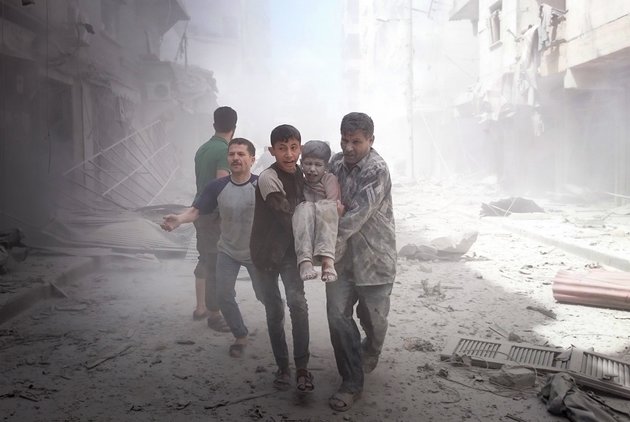
People carry an injured boy after airstrikes on Aleppo on Thursday. Nearly 250 civilians have died in nine straight days of bombardments on the city.

BEIRUT (Reuters) - Nearly 30 air strikes hit rebel-held areas of Syria‘s northern city of Aleppo on Saturday, killing more people in a ninth straight day of bombardments by warring sides, and a temporary “calm” declared by Syrian military took hold around Damascus and in the northwest.

The violence in Aleppo, which has borne the brunt of an escalation in fighting that has all but destroyed a ceasefire deal brokered in February by Washington and Moscow, has killed nearly 250 people since April 22, a monitoring group said.

It has also contributed to the break up of peace talks in Geneva, which the main opposition walked out of last week.

A temporary “regime of calm”, or lull in fighting, announced by the Syrian army late on Friday, which Damascus said was designed to salvage the wider ceasefire deal, appeared to hold in the capital and areas in its suburbs, as well as parts of northwest coastal province Latakia. Aleppo had not been included in the plan for a lull.

At least five people were killed in Aleppo early on Saturday in the latest round of air strikes, which were believed to have been carried out by Syrian government warplanes, the Syrian Observatory for Human Rights said.

The British-based monitoring group put the civilian death toll in government and rebel bombardments of neighborhoods in Aleppo since April 22 at nearly 250.

This figure included around 140 people killed by government-aligned forces in air strikes and shellings of rebel-held areas, including 19 children, it said. Insurgent shelling of government-held areas killed 96 people, including 21 children.

Aleppo, Syria‘s largest city before the war, has been divided for years between rebel and government zones. Full control would be the most important prize for President Bashar al-Assad, who has been fighting to keep hold of his country throughout a five-year civil war.

A BIT QUIETER’


Observatory director Rami Abdulrahman said government-held areas of Aleppo were “a bit quieter today”, but that shells fired by rebels were still intermittently hitting.

Farther southwest, “there aren’t clashes in Latakia, there aren’t clashes in Ghouta (Damascus suburbs),” only some lower-level violence between rival rebel groups outside Damascus, Abdulrahman said, referring to the lull in fighting announced by the army.

A resident of Western Ghouta, which is under government siege, said shellings appeared to have ceased around the capital in the hours after the start of the lull at 1 a.m. (2200 GMT on Friday).

“There has been no military activity and no sound of bombardments in nearby areas, no sound of shelling or of warplanes,” the resident, Maher Abu Jaafar, told Reuters via internet messenger.

“It’s the opposite of last night, when there was a lot of bombing and the sounds of rockets and shells.

”Syrian helicopters later in the day dropped a number of barrel bombs southwest of Damascus but outside the area where the lull in fighting was meant to take place, the Observatory said.

Abu Jaafar said he heard several explosions in the afternoon.

A Friday statement from the Syrian army did not explain any detail what military or non-military action the “regime of calm” would entail.

It said it would last for 24 hours in Eastern Ghouta and Damascus and for 72 hours in areas of the northern Latakia countryside.

The United Nations has called on Moscow and Washington to help restore the ceasefire to prevent the complete collapse of talks aimed at ending a conflict in which more than 250,000 people have been killed and millions displaced.

Aid agencies have continued to deliver aid in the west of the country, but say that access is not regular enough and that many Syrians in need still cannot be reached.

The International Committee for the Red Cross said on Saturday fresh aid had begun to enter the towns of Zabadani and Madaya, where there were reports of starvation earlier this year due to a siege by government forces and their allies.

Trucks simultaneously entered al-Foua and Kefraya in the northwest province of Idlib, which are surrounded by insurgents.

Source: http://www.huffingtonpost.com/entry/syria-aleppo-death-toll_us_5724d05ce4b01a5ebde5cc00

Islam in Indonesia

Islam in Indonesia


Indonesia is constitutionally a secular state (but the government officially recognises only six formal religions), with Islam being the dominant religion in the country. Indonesia also has a larger Muslim population than any other country in the world, with approximately 202.9 million identifying themselves as Muslim (87.2% of Indonesia's total population in 2011).

Based on demographic statistics, 99% of Indonesian Muslims mainly follow the Shafi'i school of Sunni jurisprudence, although when asked, 56% does not adhere to any specific denomination.


History
Spread of Islam (1200–1600)

There is evidence of Arab Muslim traders entering Indonesia as early as the 8th century.[7] Indonesia's historical inhabitants were animists, Hindus and Buddhists.[8] However it was not until the end of the 13th century that the spread of Islam began.[7]

The spread, although at first introduced through Arab Muslim traders, continued to saturate through the Indonesian people as local rulers and royalty began to adopt it, subsequently their subjects would mirror their conversion. The spread of Islam continued as Muslim traders married the local women, with some of the wealthier traders marrying into the families of the ruling elite.[9]

In general, traders and the royalty of major kingdoms were the first to adopt the new religion. By the end of the thirteenth century, Islam had been established in Northern Sumatra; by the fourteenth in northeast Malaya, Brunei, the southwestern Philippines and among some courts of coastal East and Central Java; and the fifteenth in Malacca and other areas of the Malay Peninsula. Dominant kingdoms included Samudra Pasai in northern Sumatra, Demak Sultanate and Mataram in Central Java, and the sultanates of Ternate and Tidore in the Maluku Islands to the east.

Through assimilation related to trade, royal conversion, and conquest, Islam had supplanted Hinduism and Buddhism as the dominant religion of Java and Sumatra by the end of the 16th century. The eastern islands remained largely animist until adopting Islam and Christianity in the 17th and 18th centuries, whereas Bali still retains a Hindu majority.[10] During this process "cultural influences from the Hindu-Buddhist era were mostly tolerated or incorporated into Islamic rituals".[7]

Despite being one of the most significant developments in Indonesian history, historical evidence is fragmentary and generally uninformative such that understandings of the coming of Islam to Indonesia are limited; there is considerable debate amongst scholars about what conclusions can be drawn about the conversion of Indonesian peoples.[11] The primary evidence, at least of the earlier stages of the process, are gravestones and a few travellers' accounts, but these can only show that indigenous Muslims were in a certain place at a certain time. This evidence cannot explain more complicated matters such as how lifestyles were affected by the new religion or how deeply it affected societies. It cannot be assumed, for example, that because a ruler was known to be a Muslim, that the process of Islamisation of that area was complete; rather the process was, and remains to this day, a continuous process in Indonesia. Although it is known that the spread of Islam began in the west of the archipelago, the fragmentary evidence does not suggest a rolling wave of conversion through adjacent areas; rather, it suggests the process was complex and slow.

By the late fifteenth century, the Majapahit Empire in Java had begun its decline. This last Hindu kingdom in Java fell under the rising power of the Islamized Sultanate of Demak in the 1520s; in 1527, the Muslim ruler renamed newly conquered Sunda Kelapa as Jayakarta meaning "precious victory" which was eventually contracted to Jakarta. Islam in Java then began to spread formally, building on the spiritual influences of the Wali Songo (or Nine Saints).

European colonisation

The Dutch entered the region in the 17th century due to its lucrative wealth established through the region's natural resources and trade. The Maluku Islands in the Indonesian archipelago were known as the "spice islands". The country's natural spices, including nutmeg, pepper, clove, were highly prized. Other popular trade items of the area include sandalwood, rubber and teak.[12]

Although the entering of Indonesia resulted in a monopoly of the central trading ports, through closed trading ports, this helped the spread of Islam, as the local Muslim traders relocated to the smaller more remote ports, establishing Islam into the more rural provinces of the region.[12]

Towards the beginning of the 20th century "Islam became a rallying banner to resist colonialism"[7] There was a move, inspired by the Islamic scholar, Muhammad 'Abduh, to return to the original scripture of the religion. The movement "built schools that combined an Islamic and secular curriculum" and was unique in that it trained women as preachers for women.[7] The activities of the reformers and the reactions of their opponents, Indonesian society became more firmly structured along communal (aliran) rather than class lines.[13]

The Minangkabau ulema played an important role in the early reform movement.[14]:353 In 1906, Tahir bin Jalaluddin published al-Iman, the Malay newspaper in Singapore. Five years later followed publication of al-Munir newspaper in Padang. In the first 20th century, Muslim modernist school arose in West Sumatra, such as Adabiah (1909), Diniyah Putri (1911), and Sumatera Thawalib (1915). Later, Islamic movement also developed in Java with the birth of the NU and Muhammadiyah.[14]:356

Post independence

When Indonesia declared independence in 1945, it became the second largest Muslim-majority nation in the world; following the separation of Bangladesh from Pakistan in 1971, it emerged as the most populous Muslim country in the world. Today about 88% of Indonesia's 235 million people is Muslim.

Upon independence there was significant controversy surrounding the role of Islam in politics; this caused enormous tensions. Eventually, "Indonesia adopted a civil code instead of an Islamic one".[12]

In the New Order years (Suharto's presidency), there was an intensification of religious belief amongst Muslims.[15] Under the Suharto regime, all Islamic parties were forced to unite under one government-supervised Islamic party, the Partai Persatuan Pembangunan (Party for Unity and Development or PPP).[7] With Suharto's resignation in 1998, "the structure that repressed religion and society collapsed".[7]

Currently "Muslims are now fully represented in the democratically elected parliament".[7] However, some critics assert that this has led to the emergence of such extremist groups as Laskar Jihad and Jemaah Islamiyah. Abu Bakar Bashir is an example of an extremist leader, exiled from Indonesia under Suharto, who returned to re-establish a support base.


Demographics

Muslims constitute a majority in most regions of Java, Sumatra, West Nusa Tenggara, Sulawesi, coastal areas of Kalimantan, and North Maluku. Muslims form distinct minorities in Papua, Bali, East Nusa Tenggara, parts of North Sumatra, most inland areas of Kalimantan, and North Sulawesi. Together, these non-Muslim areas originally constituted more than one third of Indonesia prior to the massive transmigration effort sponsored by the Suharto government and recent spontaneous internal migration.

Internal migration has altered the demographic makeup of the country over the past three decades. It has increased the percentage of Muslims in formerly predominantly Christian eastern parts of the country. By the early 1990s, Christians became a minority for the first time in some areas of the Maluku Islands. While government-sponsored transmigration from heavily populated Java and Madura to less populated areas contributed to the increase in the Muslim population in the resettlement areas, no evidence suggests that the Government intended to create a Muslim majority in Christian areas, and most Muslim migration seemed spontaneous. Regardless of its intent, the economic and political consequences of the transmigration policy contributed to religious conflicts in Maluku, Central Sulawesi, and to a lesser extent in Papua.

Organisations

Nahdlatul Ulama (NU), the largest "traditionalist" organisation, focuses on many of the activities such as social, religious and education and indirectly operates a majority of the country's Islamic boarding schools. Claiming approximately 40 million followers, NU is the country's largest organisation and perhaps the world's largest Islamic group.[16][17] Founded in 1926, NU has a nationwide presence but remains strongest in rural Java. It follow ideology of Ahle Sunnah wal Jamaah with Sufism of Imam Ghazali and Junaid Bagdadi. Many NU followers give great deference to the views, interpretations, and instructions of senior NU religious figures, alternately called "Kyais" or "Ulama." The organisation has long advocated religious moderation and communal harmony.

The leading national "modernist" social organisation, Muhammadiyah, has branches throughout the country and approximately 29 million followers.[18] Founded in 1912, Muhammadiyah runs mosques, prayer houses, clinics, orphanages, poorhouses, schools, public libraries, and universities. On 9 February, Muhammadiyah's central board and provincial chiefs agreed to endorse the presidential campaign of a former Muhammadiyah chairman. This marked the organisation's first formal foray into partisan politics and generated controversy among members.

A number of smaller Islamic organisations cover a broad range of Islamic doctrinal orientations. At one end of the ideological spectrum lies the controversial Islam Liberal Network (JIL), which aims to promote a pluralistic and more liberal interpretation of Islamic thinking.

Equally controversial are groups at the other end of this spectrum such as Hizbut Tahrir Indonesia (HTI), which advocates a pan-Islamic caliphate, the Indonesian Mujahedeen Council (MMI), which advocates implementation of Shari'a as a precursor to an Islamic state, and the sometimes violent Front Pembela Islam (FPI). Countless other small organisations fall between these poles. Another small organisation, the Indonesian Islamic Propagation Institute (LDII) continues to grow.[19]

Separate from the country's dominant Islam population, a small minority of persons subscribe to the Ahmadiyya interpretation of Islam. However, this group maintains 242 branches throughout the country. In 1980 the Indonesian Council of Ulamas (MUI) issued a "fatwa" (a legal opinion or decree issued by an Islamic religious leader) declaring that the Ahmadis are not a legitimate form of Islam.

Society

To a significant degree, the striking variations in the practice and interpretation of Islam — in a much less austere form than that practised in the Middle East — in various parts of Indonesia reflect its complex history. Introduced piecemeal by various traders and wandering mystics from India, Islam first gained a foothold between the twelfth and fifteenth centuries in coastal regions of Sumatra, northern Java, and Kalimantan. Islam probably came to these regions in the form of mystical Sufi tradition. Sufism easily gained local acceptance and became synthesised with local customs. The introduction of Islam to the islands was not always peaceful, however. As Islamized port towns undermined the waning power of the east Javanese Hindu/Buddhist Majapahit kingdom in the sixteenth century, Javanese elites fled to Bali, where over 2.5 million people kept their own version of Hinduism alive. Unlike coastal Sumatra, where Islam was adopted by elites and masses alike, partly as a way to counter the economic and political power of the Hindu-Buddhist kingdoms, in the interior of Java the elites only gradually accepted Islam, and then only as a formal legal and religious context for Javanese spiritual culture.

These historical processes gave rise to enduring tensions between orthodox Muslims and more syncretistic, locally based religion — tensions that were still visible in the early 1990s. On Java, for instance, this tension was expressed in a contrast between the traditionalist santri and abangan, an indigenous blend of native and Hindu-Buddhist beliefs with Islamic practices sometimes also called Javanism, kejawen, agama Jawa, or kebatinan. The terms and precise nature of this opposition were still in dispute in the early 1990s, but on Java santri not only referred to a person who was consciously and exclusively Muslim, it also described persons who had removed themselves from the secular world to concentrate on devotional activities in Islamic schools called pesantren—literally "the place of the santri".

In contrast to the Mecca-oriented philosophy of most santri, there was the current of kebatinan, which is an amalgam of animism, Hindu-Buddhist, and Islamic — especially Sufi — beliefs. This loosely organised current of thought and practice was legitimised in the 1945 constitution and, in 1973, when it was recognised as Kepercayaan kepada Tuhan Yang Maha Esa (Indonesian: Believer of One Supreme God) that somewhat gain the status as one of the agama, President Suharto counted himself as one of its adherents. The Kebatinan or Kepercayaan have no certain prophet, sacred book, nor distinct religious festivals and rituals; it has more to do with each adherents internalised transcendental vision and beliefs in their relations with the supreme being. As the result there is an inclusiveness that the kebatinan believer could identify themselves with one of six officially recognised religions, at least in their identity card, and still maintain their kebatinan belief and way of life.

Kebatinan is generally characterised as mystical, and some varieties were concerned with spiritual self-control. Although there were many varieties circulating in 1992, kebatinan often implies pantheistic worship because it encourages sacrifices and devotions to local and ancestral spirits. These spirits are believed to inhabit natural objects, human beings, artefacts, and grave sites of important wali (Muslim saints). Illness and other misfortunes are traced to such spirits, and if sacrifices or pilgrimages fail to placate angry deities, the advice of a dukun or healer is sought. Kebatinan, while it connotes a turning away from the militant universalism of orthodox Islam, moves toward a more internalised universalism. In this way, kebatinan moves toward eliminating the distinction between the universal and the local, the communal and the individual.

Another notable view is the division between traditionalist and modernist Islam. The nature of these differences was complex, confusing, and a matter of considerable debate in the early 1990s, but traditionalists generally rejected the modernists' interest in absorbing educational and organizational principles from the West.[citation needed] Specifically, traditionalists were suspicious of modernists' support of the urban madrasa, a reformist school that included the teaching of secular topics.[citation needed] Traditionalists also sought to add a clause to the first tenet of the Pancasila state ideology requiring that, in effect, all Muslims adhere to the sharia.[20]

Despite these differences, the traditionalist Nahdlatul Ulama, the progressive Consultative Council of Indonesian Muslims (Masyumi), and two other parties were forcibly streamlined into a single Islamic political party in 1973 — the United Development Party (PPP). Such cleavages may have weakened Islam as an organised political entity, as demonstrated by the withdrawal of the Nahdlatul Ulama from active political competition, but as a popular religious force Islam showed signs of good health and a capacity to frame national debates.

Women's higher employment rate is also an important difference between Indonesian and Middle East cultures.

Religious freedom

The Indonesian Constitution provides "all persons the right to worship according to their own religion or belief" and states that "the nation is based upon belief in one supreme God." The Government generally respects these provisions; however, some restrictions exist on certain types of religious activity and on unrecognised religions.

The Ministry of Religious Affairs extends official status to seven faiths: Islam, Catholicism, Protestantism, Buddhism, Hinduism, Confucianism and Bahá’í. Religious organisations other than the six recognised faiths can register with the Government, but only with the Ministry for Culture and Tourism and only as social organisations. This restricts certain religious activities. Unregistered religious groups cannot rent venues to hold services and must find alternative means to practice their faiths.

Although it has an overwhelming Muslim majority, the country is not an Islamic state. Article 29 of Indonesia’s Constitution however affirms that “the state is based on the belief in the one supreme God.” Atheism and agnosticism are not explicitly outlawed but socially stigmatised.

Over the past 50 years, many Islamic groups sporadically have sought to establish an Islamic state, but the country's mainstream Muslim community, including influential social organisations such as Muhammadiyah and NU, reject the idea. Proponents of an Islamic state argued unsuccessfully in 1945 and throughout the parliamentary democracy period of the 1950s for the inclusion of language (the "Jakarta Charter") in the Constitution's preamble making it obligatory for Muslims to follow Shari'a. During the Suharto regime, the Government prohibited all advocacy of an Islamic state. With the loosening of restrictions on freedom of speech and religion that followed the fall of Suharto in 1998, proponents of the "Jakarta Charter" resumed advocacy efforts. This proved the case prior to the 2002 Annual Session of the People's Consultative Assembly (MPR), a body that has the power to change the Constitution. The nationalist political parties, regional representatives elected by provincial legislatures, and appointed police, military, and functional representatives, who together held a majority of seats in the MPR, rejected proposals to amend the Constitution to include Shari'a, and the measure never came to a formal vote. The MPR approved changes to the Constitution that mandated that the Government increase "faith and piety" in education. This decision, seen as a compromise to satisfy Islamist parties, set the scene for a controversial education bill signed into law in July 2003.[citation needed]

Shari'a in Aceh


Shari'a generated debate and concern during 2004, and many of the issues raised touched on religious freedom. Aceh remained the only part of the country where the central Government specifically authorised Shari'a. Law 18/2001 granted Aceh special autonomy and included authority for Aceh to establish a system of Shari'a as an adjunct to, not a replacement for, national civil and criminal law. Before it could take effect, the law required the provincial legislature to approve local regulations ("qanun") incorporating Shari'a precepts into the legal code. Law 18/2001 states that the Shari'a courts would be "free from outside influence by any side." Article 25(3) states that the authority of the court will only apply to Muslims. Article 26(2) names the national Supreme Court as the court of appeal for Aceh's Shari'a courts.[citation needed]

Aceh is the only province that has Shari'a courts. Religious leaders responsible for drafting and implementing the Shari'a regulations stated that they had no plans to apply criminal sanctions for violations of Shari'a. Islamic law in Aceh, they said, would not provide for strict enforcement of fiqh or hudud, but rather would codify traditional Acehnese Islamic practice and values such as discipline, honesty, and proper behaviour. They claimed enforcement would not depend on the police but rather on public education and societal consensus.

Because Muslims make up the overwhelming majority of Aceh's population, the public largely accepted Shari'a, which in most cases merely regularised common social practices. For example, a majority of women in Aceh already covered their heads in public. Provincial and district governments established Shari'a bureaus to handle public education about the new system, and local Islamic leaders, especially in North Aceh and Pidie, called for greater government promotion of Shari'a as a way to address mounting social ills. The imposition of martial law in Aceh in May 2003 had little impact on the implementation of Shari'a. The Martial Law Administration actively promoted Shari'a as a positive step toward social reconstruction and reconciliation. Some human rights and women's rights activists complained that implementation of Shari'a focused on superficial issues, such as proper Islamic dress, while ignoring deep-seated moral and social problems, such as corruption.


Islamic customs


There were no reports of forced religious conversion. This coincided with a continuing de-escalation of violence in the country's main areas of interreligious conflict: the eastern provinces of Maluku, North Maluku, and Central Sulawesi.

Some Muslim, Christian, Hindu, and Buddhist holy days are national holidays. Muslim holy days celebrated include the Isra and Mi'raj, Idul Fitr, Idul Adha, the Islamic New Year, and the Prophet's Birthday. National Christian holy days are Christmas Day, Good Friday, Pentecost, Easter and the Ascension of Christ. Three other national holidays are the Hindu holiday Nyepi, the Buddhist holiday Waisak, and Chinese New Year, celebrated by Confucians and other Chinese. On Bali all Hindu holy days are regional holidays, and public servants and others did not work on Saraswati Day, Galungan, and Kuningan.

The Government has a monopoly on organising the hajj pilgrimage to Mecca, and in February, following the latest hajj, the Department of Religious Affairs drew sharp criticism for mismanaging the registration of approximately 30,000 prospective pilgrims after they had paid the required fees[citation needed]. The Government unilaterally expanded the country's quota of 205,000 pilgrims, claiming it had informal approval from the Saudi Government, an assertion that proved incorrect. Members of the House of Representatives have sponsored a bill to set up an independent institution, thus ending the department's monopoly.